
Emergency Air Duct Cleaning Near Me: What Fairfield Homeowners Should Do First
Calling for emergency duct cleaning before you’ve contained the source is like mopping during a leak – the right move, in the wrong order. If smoke, sewage odor, or rodent droppings have gotten into your ducts in Fairfield, the first thing to do isn’t dial a cleaning company. It’s shut the system down and find the source. We’re the team at Duct Cleaning Fairfield, and in our experience the jobs that go sideways are the ones where a homeowner skipped the containment step and a cleaning crew just started blowing air around. This guide walks you through what to do in that first hour, before any truck shows up.
If you’d rather not handle it alone, you can call us at (844) 834-3074 for a free estimate. We answer 24/7. Fast dispatch from 7am to 7pm, Sunday through Friday.
What Actually Counts as a Duct Emergency in Fairfield?
A true duct emergency in Fairfield is smoke or fire odor inside the system, confirmed rodent activity with visible droppings, or a raw sewage backup near the air handler. A musty smell, visible dust at the registers, or a mild allergy flare-up is urgent but not an emergency – those can wait for a scheduled visit.
Here’s how we sort them, because the difference matters. Booking a standard cleaning for a non-emergency is fine. Booking a standard cleaning for a genuine contamination event can make things worse by spreading soot or fecal matter through the house.
- True emergencies: Post-fire smoke or soot in the ducts; confirmed rodent intrusion with droppings or nesting material; raw sewage that has reached the air handler or supply plenum; chemical or solvent spills pulled into the return.
- Urgent, not emergency: A strong musty or mildewy smell; a sudden increase in dust after renovation; visible mold at a register; a system that smells off but is otherwise running normally.
- Not urgent: Routine dust buildup, a first-time inspection request, or wanting cleaner air before allergy season.
In Fairfield, the smoke category tends to come up after summer wildfire smoke drifts inland and gets pulled into return air while the system is running. The rodent category comes up more in older homes where ducts run through garages or crawl-adjacent spaces. Knowing which one you’re dealing with changes everything about the response.
The First Hour: What to Do Before You Call Anyone in Fairfield
Before any technician is called to a Fairfield home, the first-hour protocol is simple: turn the HVAC system off, identify or isolate the contamination source, and document what you see for insurance. Skipping these steps is the single most common mistake we hear about when homeowners call us after things have already gone wrong.
Here’s the order that works:
- Shut the system off at the thermostat. Every minute the blower runs, it pushes whatever is in the ducts further into the living space and into the return. Off means off.
- Close the registers in the affected rooms if you can. This limits the migration of odor or particulate into those spaces.
- Identify the source. A smoldering smell might be the furnace, not the ducts. A sewage smell might be a plumbing backup under the slab with vapor reaching the air handler. Rodent droppings might be at a single register or throughout the return trunk.
- Isolate if possible. If you know a kitchen renovation kicked up drywall dust into one return, blocking that return with a clean towel limits the spread while you wait.
- Document everything. Photos of droppings, soot at the register, the source area, and the thermostat setting. Your insurance adjuster will want timestamps and detail, not a general “the house smelled.”
If you’re unsure whether the source is the ducts or something else, that’s exactly the moment to call. We answer 24/7 and can talk through what you’re seeing before deciding whether a same-day visit makes sense.
Why Standard Duct Cleaning Equipment Isn’t Enough for Soot or Rodent Contamination
Post-fire soot and rodent fecal matter aren’t dust. They’re hazardous particulates that require negative containment, PPE protocols, and often separate remediation before duct cleaning even begins. A standard duct cleaning rig with a shop-vac-sized vacuum and an air whip will dislodge that material and push it into the room.
This is where the equipment conversation becomes serious, and it’s why we run the setups we do:
- Abatement Technologies HEPA filtration for captured containment. The same HEPA standard used in remediation work, so particulates are trapped in the unit rather than released into the living space.
- Nikro vacuum equipment for high-CFM negative air pressure. That’s what actually pulls dislodged debris out of the duct instead of letting it settle back.
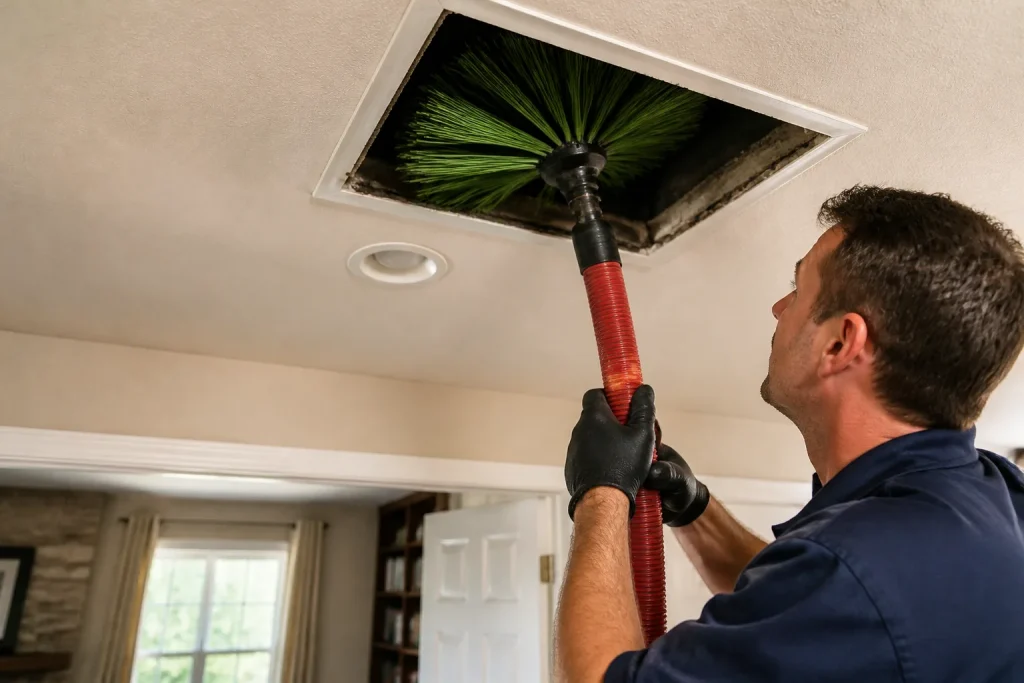
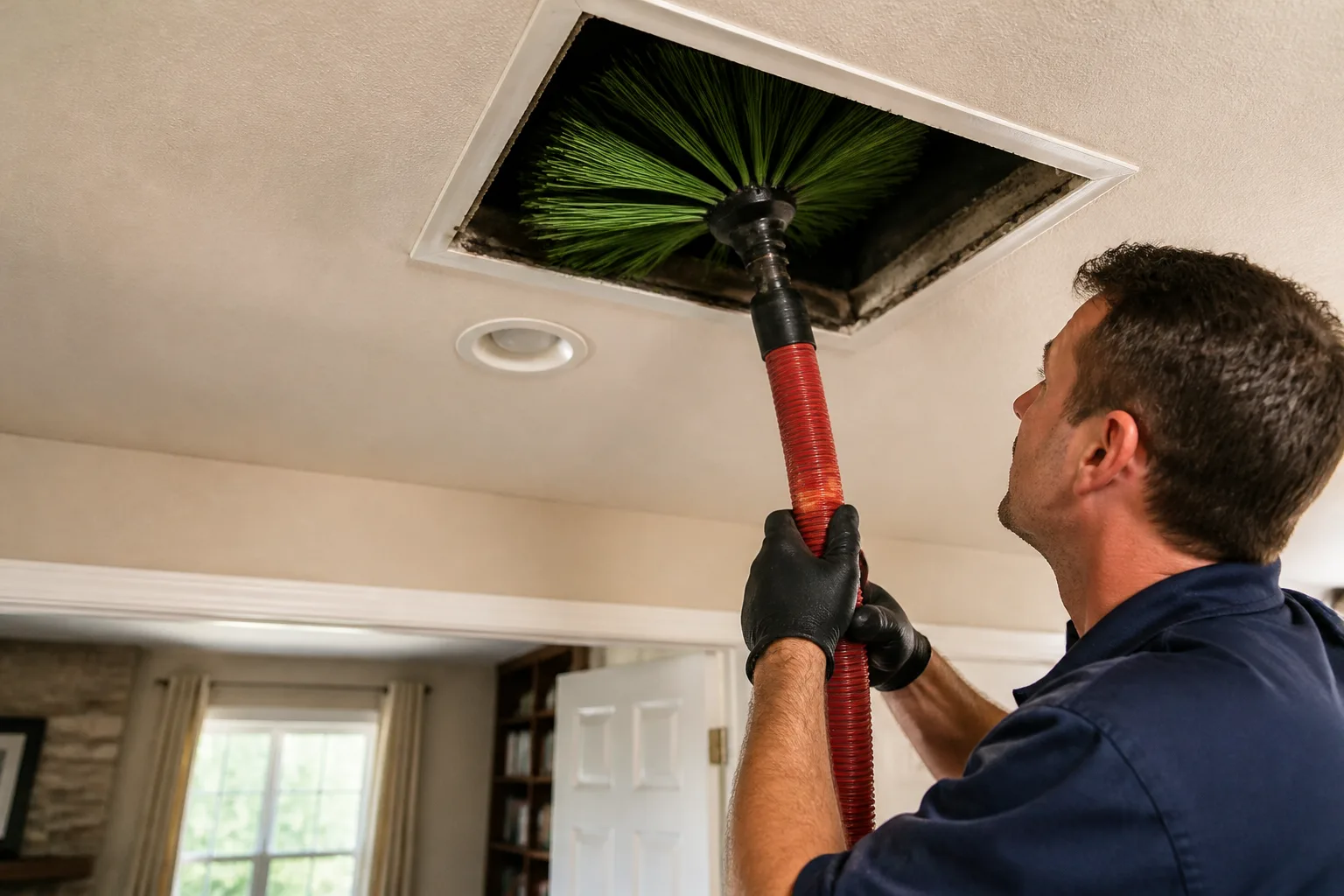
- Rotobrush rotary brush system for contact-based cleaning when the contamination has adhered to duct walls. Air whips alone can’t touch caked-on soot or dried rodent waste.
For true post-fire or sewage situations in Fairfield, cleaning is often the last step, not the first. The source remediation comes first. Fecal contamination gets a PPE protocol and containment before anyone opens a duct. Soot gets assessed for what type it is and how deep it penetrated. Only then does duct cleaning happen, and it happens inside a containment setup that keeps the rest of the house clean. Any company that shows up for a genuine emergency and starts with a shop vac and no containment is doing the wrong job.
What to Tell a Fairfield Dispatcher When You Call
When you call a duct cleaning company in Fairfield about an emergency, be specific: name the contamination type, say whether the system has been running since the event, give your home’s square footage, and describe the duct access type. Those four details let a good dispatcher send the right equipment and the right technician instead of a generic cleaning visit.
Here’s the full list we ask about, and what each answer changes:
- Contamination type: Fire smoke? Sewage? Rodent droppings? Solvent? Each one triggers a different protocol.
- System status: Has the HVAC been running since the event, and for how long? That tells us how far contamination may have traveled through the supply and return.
- Square footage: Roughly, to the nearest 500 square feet. It sizes the equipment and job scope.
- Duct access: Attic? Crawl space? Basement? Rigid metal or flex? This affects setup, and it affects time.
- Any occupants with breathing concerns: Asthma, allergies, or a young child in the home. We plan around it.
If you can answer three of those five, you’re ahead of most callers. If you can answer all five, you’ve just helped us give you a better estimate on the phone before anyone drives out.
What a Legitimate Emergency Response Looks Like (and What Doesn’t)
A legitimate emergency duct response in Fairfield looks like a company that asks about contamination type and source before quoting, arrives with HEPA containment and negative air pressure equipment, and describes a sequence of steps rather than a single cleaning pass. What it shouldn’t look like is a company that offers to show up fast and charges a premium for a standard cleaning.
We’ve heard enough secondhand stories from homeowners that we know the pattern. The warning signs:
- A guarantee of arrival within minutes on any call, with no questions about the source.
- An emergency upcharge quoted before anyone has asked what the contamination is.
- A crew that arrives with portable consumer equipment and starts cleaning without containment.
- No discussion of what happens after cleaning: how the source gets fixed, how the ducts get verified clean, how the insurance documentation is handled.
What we do differently: the price is set per job by a written estimate, and the written estimate is based on what we find when we assess. If we find rodent damage, we fix the penetration as part of our air duct cleaning and repair work rather than cleaning around it. If the source is a plumbing backup, we say so and talk through remediation before any duct work begins. Fairfield homeowners deserve that clarity before anyone touches the system.
When to Call a Pro (and When to Wait for a Scheduled Visit)
Call us right away if the contamination is smoke, soot, sewage, or confirmed rodent droppings in the ducts, or if you’re unsure and want to talk through it. Wait and schedule a normal visit if it’s dust, a mild musty smell, or a first inspection – those don’t need a same-day slot, and they don’t need an emergency price.
The line between the two is not always obvious, so here’s our shorthand: if you’d hesitate to breathe the air coming out of a register right now, call. If the air just feels stale or the smell is faint, schedule. We answer 24/7 either way, and we’ll tell you honestly which one it is.
Related services in Fairfield: dryer vent cleaning for lint buildup and the fire risk that comes with it, and Fairfield for our full list of services in the area.
Key Takeaways
- Shut the HVAC off before calling anyone – running the system spreads contamination through the house.
- Know the difference: smoke, sewage, and confirmed rodent droppings are emergencies; musty smell and visible dust are not.
- Soot and rodent waste need HEPA containment and negative pressure, not a standard cleaning pass with a shop vac.
- Tell the dispatcher the contamination type, system status, square footage, and duct access – those four answers change the response.
- Beware companies that quote an emergency upcharge before asking what the contamination is.
The Bottom Line
The right order when something gets into your ducts in Fairfield is: contain first, then document, then call. Contain means HVAC off and source identified. Document means photos for insurance. Call means a company that asks the right questions and shows up with HEPA containment and professional extraction equipment, not a shop vac and a premium rate.
We run Rotobrush and Nikro equipment on every job, with Abatement Technologies HEPA containment when the situation calls for it. We repair what we find, not just clean over it. And the price is set per job by a written estimate before any work begins.
If you’re in Fairfield and need help, Duct Cleaning Fairfield offers free estimates – call (844) 834-3074. We answer 24/7. Fast dispatch from 7am to 7pm, Sunday through Friday. If you’d rather start with a scheduled visit than an emergency call, that works too; our team can take a look at your Duct Cleaning Fairfield options and map out what makes sense for your home.
Frequently Asked Questions
The price is set per job by a written estimate, and we don’t charge an emergency premium. Call (844) 834-3074 for an exact quote – estimates are free.
No. Turn the system off at the thermostat and keep it off until the contamination source is isolated or removed. Running the blower pushes soot, droppings, or odor through the supply and return and into the living space. Call us at (844) 834-3074 to talk through the situation – we answer 24/7.
Cheaper quotes usually mean cheaper equipment and less containment. A standard cleaning pass with a portable vacuum is not the same job as a HEPA-contained extraction with negative air pressure. If the quote doesn’t mention containment for smoke or rodent contamination, ask why. Call (844) 834-3074 for an exact quote – estimates are free.
Ask for before-and-after photos of the specific ducts cleaned, and ask what equipment was used for extraction. At Duct Cleaning Fairfield, we document the condition of the ducts and can walk you through what was found and what was removed. Call (844) 834-3074 for a free estimate and we’ll lay out the process before any work begins.
Written by the team at Duct Cleaning Fairfield.
Need Air Duct Cleaning Help?
Call Duct Cleaning Fairfield - licensed & insured, here with fast help in Fairfield.
(844) 834-3074